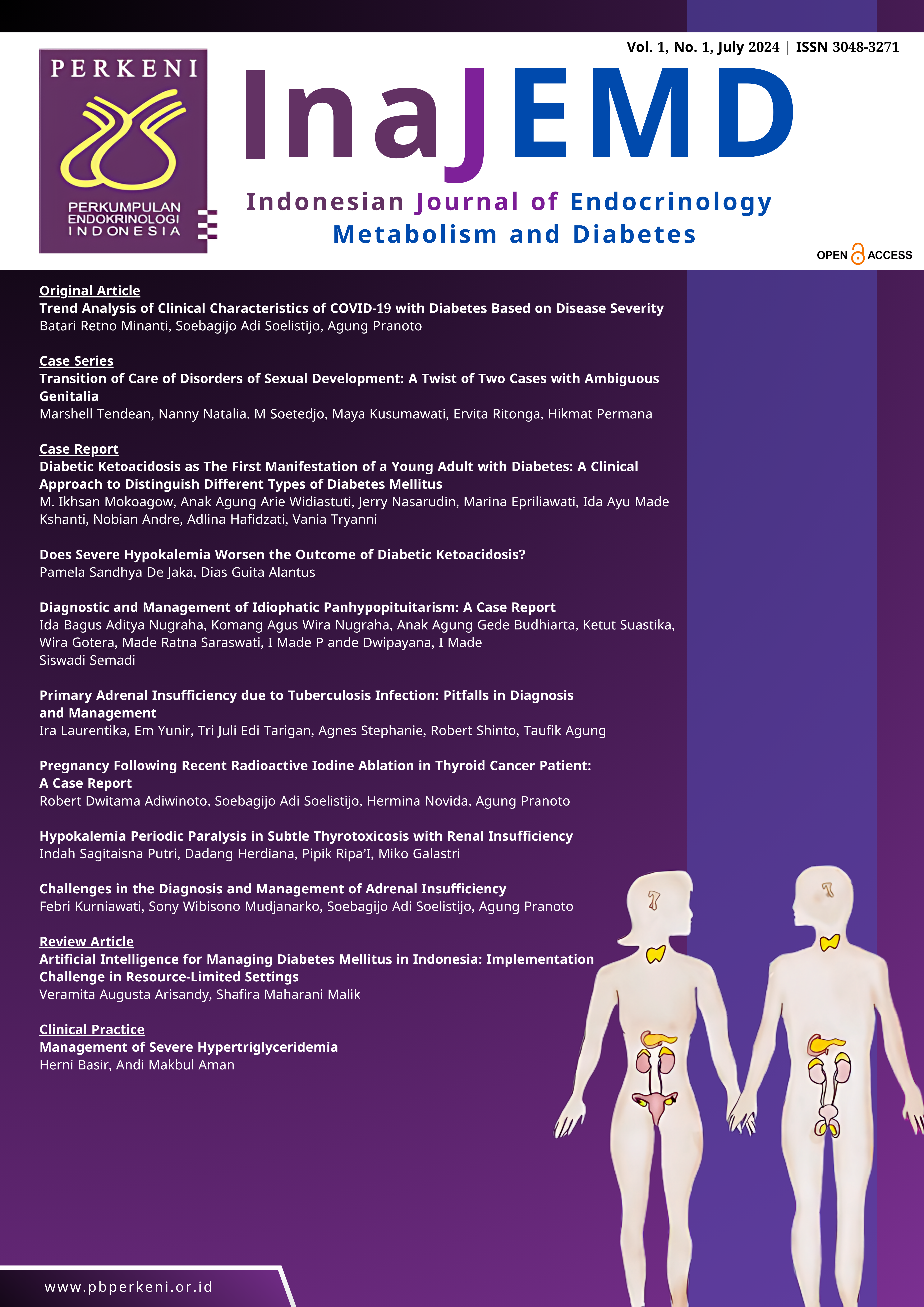
Diagnostic and Management of Idiophatic Panhypopituitarism A Case Report
DOI:
https://doi.org/10.66266/inajemd.v1i1.5Keywords:
Panhypopituitarism, hypoadrenalism, hypogonadism, hypothyroidism, growth hormonAbstract
Hypopituitarism is marked by decreased secretion of one, several, or all anterior or posterior pituitary hormones. A rare disorder, panhypopituitarism indicates the loss of all the pituitary hormones but often is used in clinical practice to describe a patient's deficiency in growth hormone, gonadotropins, corticotropin, and thyrotropin in whom the posterior pituitary function remains intact. Hypopituitarism may occur because of diverse etiologies and lead to substantial morbidity and mortality. Despite advances in the diagnosis and management of pituitary disorders, hypopituitarism is still associated with increased long-term cardiovascular mortality. We report a rare case of a 22-year-old boy with idiopathic panhypopituitarism. The patient has deficiency of growth hormone, gonadotropin, corticotropin, and thyrotropin, yet the underlying etiology remains unknown in this patient because of lack of imaging data. This is very challenging to do prompt diagnosis and management of panhypopituitarism. The management is needing multiple hormone
replacement therapy, based on the result of pituitary hormone laboratory examination. Prompt treatment is needed to prevent further morbidity and mortality in this patient. hypothyroidism, growth hormon
Downloads
References
1. Tritos NA, Klibanski A. Hypopituitarism. In: Maftin G. Endocrine and metabolic Medical Emergencies: A Clinician's Guide. 2nd ed. New Jersey: John & Wiley ltd; 2018.
2. Toogood AA, Strewart PM. Hypopituitarism: clinical features, diagnosis, and management. Endocrinol Metab Clin N Am. 2008; 37: 235-61.
3. Mitchell-Brown F, Stephens-DiLeo R. Managing panhypopituitarism in adults. Nursing. 2017;47(12):26–31.
4. Pekic S, Popovic V. Expanding the cause of hypopituitarism. Eur J of Endocrinol. 2017; 176:269-82.
5. Schneider HJ, AiJuliti G, Kreitshmann-Andermahr I, Stalla GK, Ghigo E. Hypopituitarism. Lancet. 2007; 28:1461-70.
6. Han T, Bouloux P. What is the Optimal Therapy for Young Males with Hypogonadotropic Hypogonadism? Clin Endocrinol. 2010; 72:731–737.
7. Fleseriu M, Hashim IA, Karavitaki N, Melmed S, Murad MH, Salvatori R, Samuels MH. Hormonal replacement in hypopituitarism in adults: an Endocrine Society Clinical Practice Guideline. J Clin Endocrinol Metab. 2016; 101(11):3888-921
8. Higham CE, Trainer PJ. Pituitary hormone replacement. medicine. 2017; 1:1-5.
9. Fraietta H, Zylberstejn D, Esyeves S. Review: Hypogonadotropic Hypogonadism Revisited. Clinics. 2013;68(S1):81-88.
10. Gilbert J. Initiating growth hormone therapy in children. Nurse Prescribing. 2018;16(6):268-73.
Downloads
Published
Issue
Section
License
Copyright (c) 2024 InaJEMD - Indonesian Journal of Endocrinology Metabolic and Diabetes

This work is licensed under a Creative Commons Attribution-NonCommercial-NoDerivatives 4.0 International License.
Authors retain copyright and grant the Indonesian Journal of Endocrinology, Metabolism and Diabetes (InaJEMD) the right of first publication with the work simultaneously licensed under a Creative Commons Attribution-NonCommercial-NoDerivatives 4.0 International License (CC BY-NC-ND 4.0) that allows others to share the work with an acknowledgement of the work's authorship and initial publication in this journal.
© Indonesian Journal of Endocrinology, Metabolism and Diabetes (InaJEMD). Published by the Indonesian Society of Endocrinology (PERKENI).