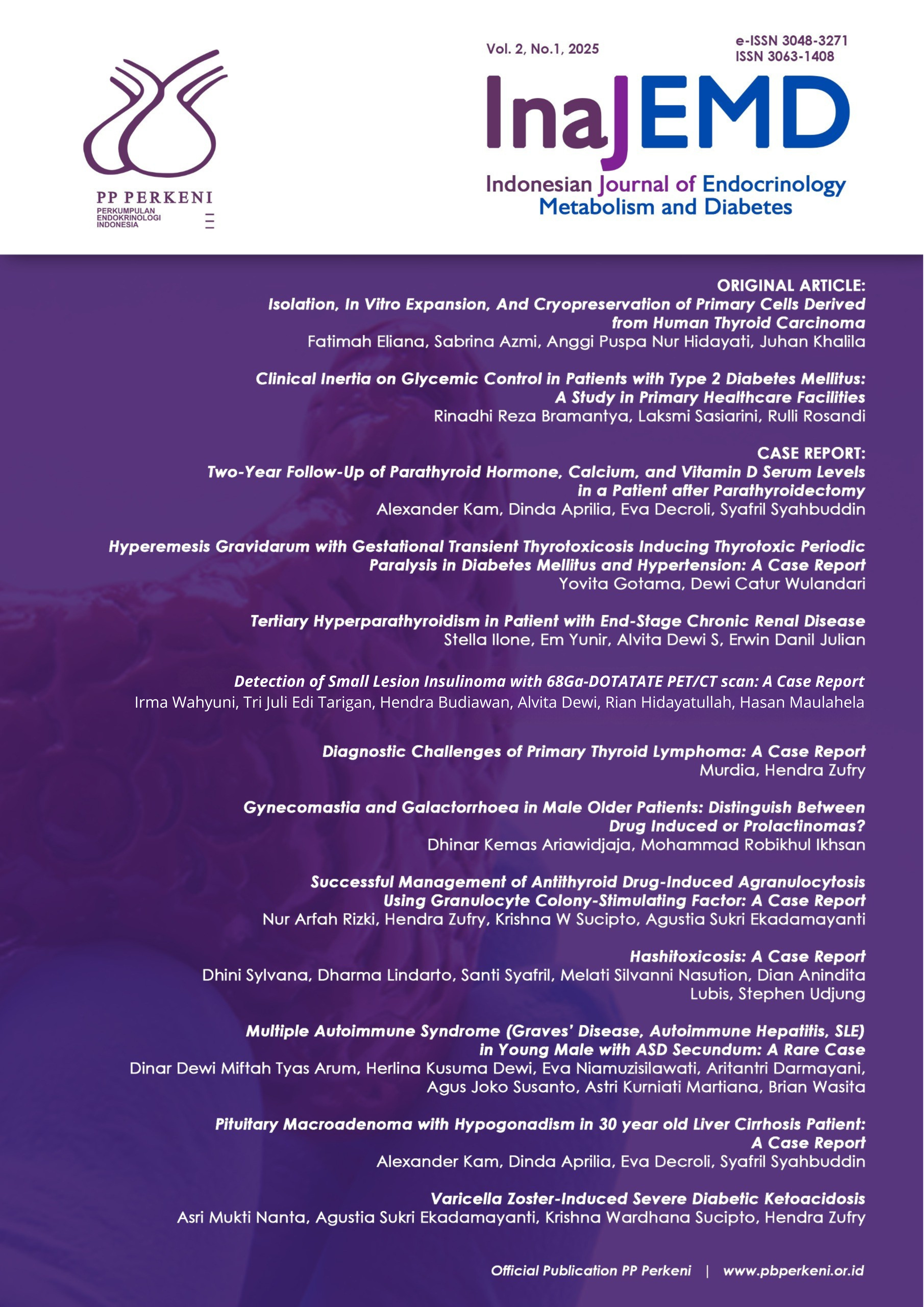
Successful Management of Antithyroid Drug-Induced Agranulocytosis Using Granulocyte Colony-Stimulating Factor: A Case Report
DOI:
https://doi.org/10.66266/inajemd.v2i1.43Keywords:
Agranulocytosis, grave's disease, antithyroid drug, granulocyte colony-stimulating factorAbstract
Agranulocytosis is a rare condition and occurs in all age groups. Incidence ranges from 6 to 8 cases per million population per year. About 70% of the cases are found to be involved with medication usage. The use of granulocyte colony-stimulating factor (G-CSF) is effective for ATD-induced agranulocytosis, though some patients do not respond. A 22-year-old female was diagnosed with Grave's disease (GD) three months ago and began using Methimazole (MMI) at an initial dose of 20 mg/day. She was taken to the emergency room after complaining of a fever and stomachache for a week. Laboratories: The patient had leucopenia (white blood cell count 2040/mm3) and severe neutropenia, with an absolute neutrophil count (ANC) of 122.4/μL, thyroid stimulating hormone (TSH) of 0.005 IU/mL, and free thyroxine (FT4) of 46.81 pmol/L. The patient received G-CSF, which normalized her neutrophil counts after the first injection and resolved her fever. She was recommended to quit methimazole therapy. MMI is thionamide used as a first-line treatment for GD. The most severe side effect is agranulocytosis. Agranulocytosis can have various presentations; it most frequently occurs between 2 weeks and 3 months after the initiation of treatment. If the patient recovers, granulocytes begin to reappear in the periphery within a few days to 3 weeks. This drug-induced agranulocytosis is a lethal condition but reversible if recognized early and treated accordingly. G-CSF may shorten the recovery period.
Downloads
References
1. Sedhai YR, Lamichhane A, Gupta V. Agranulocytosis. In: StatPearls [Internet]. Treasure Island (FL): StatPearls Publishing; 2023 [cited 2025 Jul 3].
2. García G.C, Navarro E, Alcázar V, López-Guzmán A, Arrieta F, Anda E, et al. Therapeutic management and long-term outcome of hyperthyroidism in patients with antithyroid-induced agranulocytosis: A retrospective, multicenter study. J Clin Med. 2023;12(20):6556.
3. MacKay M, Clewis MC, Sweet P. Antithyroid drug-induced agranulocytosis: A case report. Cureus. 2023;15(11):e48038.
4. Theyab A, Alsharif KF, Alzahrani KJ, Oyouni AAA, Hawsawi YM, Algahtani M, et al. New insight into strategies used to develop long-acting G-CSF biologics for neutropenia therapy. Front Oncol. 2023;12:1026377.
5. Link H. Current state and future opportunities in granulocyte colony-stimulating factor (G-CSF). Support Care Cancer. 2022;30(9):7067-77.
6. Yoshimura Y, Matsushima K, Goshima Y, Hoshino Y, Nakashima S, Inaba T, et al. A case of methimazole-induced acute pancreatitis with an HLA allele causing antithyroid drug-induced agranulocytosis. J Endocr Soc. 2022;6(5):bvac038.
7. Malboosbaf R, Azizi F. Long-term treatment with antithyroid drugs: Efficacy and safety. Int J Endocrinol Metab. 2020;18(Suppl).
8. Andrès E, Federici L, Weitten T, Vogel T, Alt M. Recognition and management of drug-induced blood cytopenias: the example of drug-induced acute neutropenia and agranulocytosis. Expert Opin Drug Saf. 2008;7(4):481-9.
9. Vicente N, Cardoso L, Barros L, Carrilho F. Antithyroid drug-induced agranulocytosis: State of the art on diagnosis and management. Drugs R D. 2017;17:91-6.
10. Mariya A, Sreenath R, Maria D. A case report of carbimazole induced agranulocytosis. Indian J Pharm Pract. 2023;16(3):152-4.
11. El-Shareif HJ. Agranulocytosis: A rare complication of the thioamides. Egypt J Intern Med. 2023;35(1):59.
12. Tajiri J, Noguchi S. Antithyroid drug-induced agranulocytosis: how has granulocyte colony-stimulating factor changed therapy? Thyroid. 2005;15(3):292-7.
Downloads
Published
Issue
Section
License
Copyright (c) 2025 InaJEMD - Indonesian Journal of Endocrinology Metabolic and Diabetes

This work is licensed under a Creative Commons Attribution-NonCommercial-NoDerivatives 4.0 International License.
Authors retain copyright and grant the Indonesian Journal of Endocrinology, Metabolism and Diabetes (InaJEMD) the right of first publication with the work simultaneously licensed under a Creative Commons Attribution-NonCommercial-NoDerivatives 4.0 International License (CC BY-NC-ND 4.0) that allows others to share the work with an acknowledgement of the work's authorship and initial publication in this journal.
© Indonesian Journal of Endocrinology, Metabolism and Diabetes (InaJEMD). Published by the Indonesian Society of Endocrinology (PERKENI).