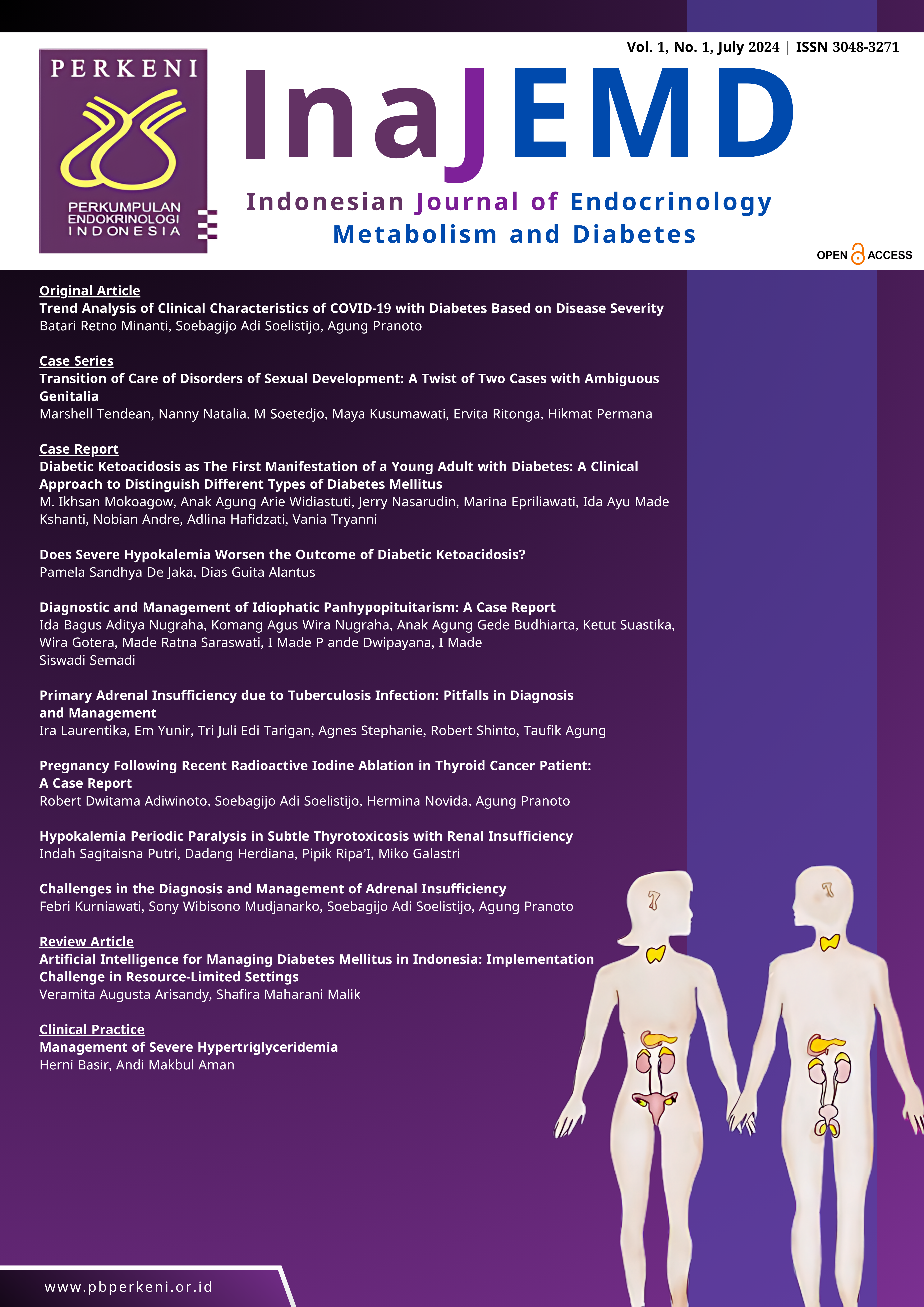
Trend Analysis of Clinical Characteristics of COVID-19 with Diabetes Based on Disease Severity
DOI:
https://doi.org/10.66266/inajemd.v1i1.1Keywords:
COVID-19 severity, clinical characteristics, bmi, glycaemic control, diabetesAbstract
Diabetes Mellitus (DM) increases the risk of COVID-19's severity and mortality than those without DM. The aim of this study was to determine the characteristics and trends by disease severity of DM patients with COVID-19. Across-sectional study examining retrospective medical records was conducted in patients with diabetes mellitus who were confirmed to have COVID-19 by reverse transcription-quantitative polymerase chain reaction (RT-qPCR). All adult patients (age > 18 years) with DM and COVID-19 registered and treated at the Surabaya Hajj General Hospital from May 2021 to the end of December 2021 were included in this study. Trends in each subject's characteristics are displayed in a graph with a trendline based on the severity of COVID-19. The highest proportion
of disease severity of DM patients with COVID-19 is mild and moderate cases (72.2%), with 27.8% severe and critical cases. The average aged of the subjects was 56.38 ± 9.60 years. The age group with the highest proportion was 50-59 (42.6%). There are slightly more female than male patients (50.4% vs. 49.6%). The tendency is that the disease's severity increases with BMI, increasing HbA1C level, low sodium level, high chloride level, and high CRP and D-dimer levels. The pattern of clinical and laboratory features of DM patients based on the severity of COVID-19 infection shows the tendency for the disease severity worsens with increasing BMI, HbA1C level, low sodium level, high chloride level, and high CRP and D- dimer levels.
Downloads
References
1. Kumar A, Arora A, Sharma P, Anikhindi SA, Bansal N, Singla V, et al. Is diabetes mellitus associated with mortality and severity of COVID-19? A meta-analysis. Diab Metab Syndr Clin Res Rev. 2020 Jul 1;14(4):535–45.
2. Abdi A, Jalilian M, Sarbarzeh PA, Vlaisavljevic Z. Diabetes and COVID-19: A systematic review on the current evidences. Diab Res Clin Pract. 2020;166:108347.
3. Singh AK, Khunti K. Assessment of risk, severity, mortality, glycemic control and antidiabetic agents in patients with diabetes and COVID-19: a narrative review. Diab Res Clin Pract. 2020;165:108266.
4. Varikasuvu SR, Dutt N, Thangappazham B, Varshney S. Diabetes and COVID-19: a pooled analysis related to disease severity and mortality. Prim Care Diab. 2021;15(1):24–7.
5. Alkundi A, Mahmoud I, Musa A, Naveed S, Alshawwaf M. Clinical characteristics and outcomes of COVID-19 hospitalized patients with diabetes in the United Kingdom: A retrospective single centre study. Diab Res Clin Pract. 2020 Jul 1;165:108263.
6. Li G, Chen Z, Lv Z, Li H, Chang D, Lu J. Diabetes Mellitus and COVID-19: Associations and Possible Mechanisms. Int J Endocrinol. 2021 Apr 7;2021:e7394378.
7. Maddaloni E, Buzzetti R. Covid-19 and diabetes mellitus: unveiling the interaction of two pandemics. Diabetes Metab Res Rev. 2020;36(7):e33213321.
8. Muniyappa R, Gubbi S. COVID-19 pandemic, coronaviruses, and diabetes mellitus. Am J Physiol-Endocrinol Metab. 2020;
9. Singh AK, Gupta R, Ghosh A, Misra A. Diabetes in COVID-19: Prevalence, pathophysiology, prognosis and practical considerations. Diabetes Metab Syndr Clin Res Rev. 2020. 14(4):303–10.
10. Gupta R, Ghosh A, Singh AK, Misra A. Clinical considerations for patients with diabetes in times of COVID-19 epidemic. Diab Metab Syndr. 2020;14(3):211.
11. Huang I, Lim MA, Pranata R. Diabetes mellitus is associated with increased mortality and severity of disease in COVID-19 pneumonia–a systematic review, meta-analysis, and meta-regression. Diabetes Metab Syndr Clin Res Rev. 2020;14(4):395–403.
12. Guo W, Li M, Dong Y, Zhou H, Zhang Z, Tian C, et al. Diabetes is a risk factor for the progression and prognosis of COVID-19. Diab Metab Res Rev. 2020;36(7):e3319.
13. Zhu L, She ZG, Cheng X, Qin JJ, Zhang XJ, Cai J, et al. Association of blood glucose control and outcomes in patients with COVID-19 and pre-existing type 2 diabetes. Cell Metab. 2020;31(6):1068–77.
14. Bode B, Garrett V, Messler J, McFarland R, Crowe J, Booth R, et al. Glycemic characteristics and clinical outcomes of COVID-19 patients hospitalized in the United States. J Diab Sci Technol. 2020;14(4):813–21.
15. Minanti BR, Soelistijo SA, Pranoto A. Characteristic profiles of patients with diabetes mellitus and COVID-19 during the second epidemic wave in East Java, Indonesia: a retrospective study. Bali Med J. 2023;12(1):1120–6.
16. Organization WH. Clinical management of COVID-19: interim guidance, 27 May 2020. World Health Organization; 2020.
17. Collaboration APCS. Body mass index and cardiovascular disease in the Asia-Pacific Region: an overview of 33 cohorts involving 310 000 participants. Int J Epidemiol. 2004;33(4):751–8.
18. Zhang Q, Wei Y, Chen M, Wan Q, Chen X. Clinical analysis of risk factors for severe COVID-19 patients with type 2 diabetes. J Diab Comp. 2020;34(10):107666.
19. Gupta S, Hayek SS, Wang W, Chan L, Mathews KS, Melamed ML, et al. Factors Associated With Death in Critically Ill Patients With Coronavirus Disease 2019 in the US. JAMA Intern Med. 2020;180(11):1436–47.
20. Nakeshbandi M, Maini R, Daniel P, Rosengarten S, Parmar P, Wilson C, et al. The impact of obesity on COVID-19 complications: a retrospective cohort study. Int J Obes. 2020;44(9):1832–7.
21. Ho JS, Fernando DI, Chan MY, Sia CH. Obesity in COVID-19: A Systematic Review and Meta-analysis. Ann Acad Med Singap. 2020;996–1008.
22. Leeuwis AE, Smith LA, Melbourne A, Hughes AD, Richards M, Prins ND, et al. Cerebral blood flow and cognitive functioning in a community-based, multi-ethnic cohort: the SABRE study. Front Aging Neurosci. 2018;10:279.
23. Maurya R, Sebastian P, Namdeo M, Devender M, Gertler A. COVID-19 severity in obesity: leptin and inflammatory cytokine interplay in the link between high morbidity and mortality. Front Immunol. 2021;2349.
24. Longmore DK, Miller JE, Bekkering S, Saner C, Mifsud E, Zhu Y, et al. Diabetes and Overweight/Obesity Are Independent, Nonadditive Risk Factors for In-Hospital Severity of COVID-19: An International, Multicenter Retrospective Meta-analysis. Diabetes Care. 2021 Jun 1;44(6):1281–90.
25. Gao F, Zheng KI, Wang XB, Sun QF, Pan KH, Wang TY, et al. Obesity Is a Risk Factor for Greater COVID-19 Severity. Diabetes Care. 2020 Jul 1;43(7):e72–4.
26. Tamara A, Tahapary DL. Obesity as a predictor for a poor prognosis of COVID-19: A systematic review. Diab Metab Syndr Clin Res Rev. 2020 Jul 1;14(4):655–9.
27. de Leeuw AJ, Oude Luttikhuis MA, Wellen AC, Müller C, Calkhoven CF. Obesity and its impact on COVID-19. J Mol Med. 2021;99:899–915.
28. Kandinata SG, Soelistijo SA, Pranoto A, Triyono EA. Random Blood Glucose, but Not HbA1c, Was Associated with Mortality n COVID-19 Patients with Type 2 Diabetes Mellitus—A Retrospective Study. Pathop. 2023(2):136–43.29.
30. Cavezzi A, Troiani E, Corrao S. COVID-19: hemoglobin, iron, and hypoxia beyond inflammation. A narrative review. Clin Pract. 2020;10(2):1271.
31. Hariyanto TI, Kurniawan A. Anemia is associated with severe coronavirus disease 2019 (COVID-19) infection. Transfus Apher Sci. 2020;59(6).
32. Sayad B, Afshar ZM, Mansouri F, Rahimi Z. Leukocytosis and alteration of hemoglobin level in patients with severe COVID-19: Association of leukocytosis with mortality. Health Sci Rep. 2020;3(4):e194.
33. Pourfridoni M, Abbasnia SM, Shafaei F, Razaviyan J, Heidari-Soureshjani R. Fluid and electrolyte disturbances in COVID-19 and their complications. BioMed Res Int. 2021;2021.
34. Malieckal DA, Uppal NN, Ng JH, Jhaveri KD, Hirsch JS. Electrolyte abnormalities in patients hospitalized with COVID-19. Clin Kidney J. 2021;14(6):1704–7.
35. Song H, Chia AZQ, Tan BKJ, Teo CB, Lim V, Chua HR, et al. Electrolyte imbalances as poor prognostic markers in COVID-19: a systemic review and meta-analysis. J Endocrinol Invest. 2023;46(2):235–59.
36. Zhang ZL, Hou YL, Li DT, Li FZ. Laboratory findings of COVID-19: a systematic review and meta-analysis. Scand J Clin Lab Invest. 2020;80(6):441–7.
37. Hu R, Han C, Pei S, Yin M, Chen X. Procalcitonin levels in COVID-19 patients. Int J Antimicrob Agents. 2020 Aug;56(2):10605.
Downloads
Published
Issue
Section
License
Copyright (c) 2024 InaJEMD - Indonesian Journal of Endocrinology Metabolic and Diabetes

This work is licensed under a Creative Commons Attribution-NonCommercial-NoDerivatives 4.0 International License.
Authors retain copyright and grant the Indonesian Journal of Endocrinology, Metabolism and Diabetes (InaJEMD) the right of first publication with the work simultaneously licensed under a Creative Commons Attribution-NonCommercial-NoDerivatives 4.0 International License (CC BY-NC-ND 4.0) that allows others to share the work with an acknowledgement of the work's authorship and initial publication in this journal.
© Indonesian Journal of Endocrinology, Metabolism and Diabetes (InaJEMD). Published by the Indonesian Society of Endocrinology (PERKENI).