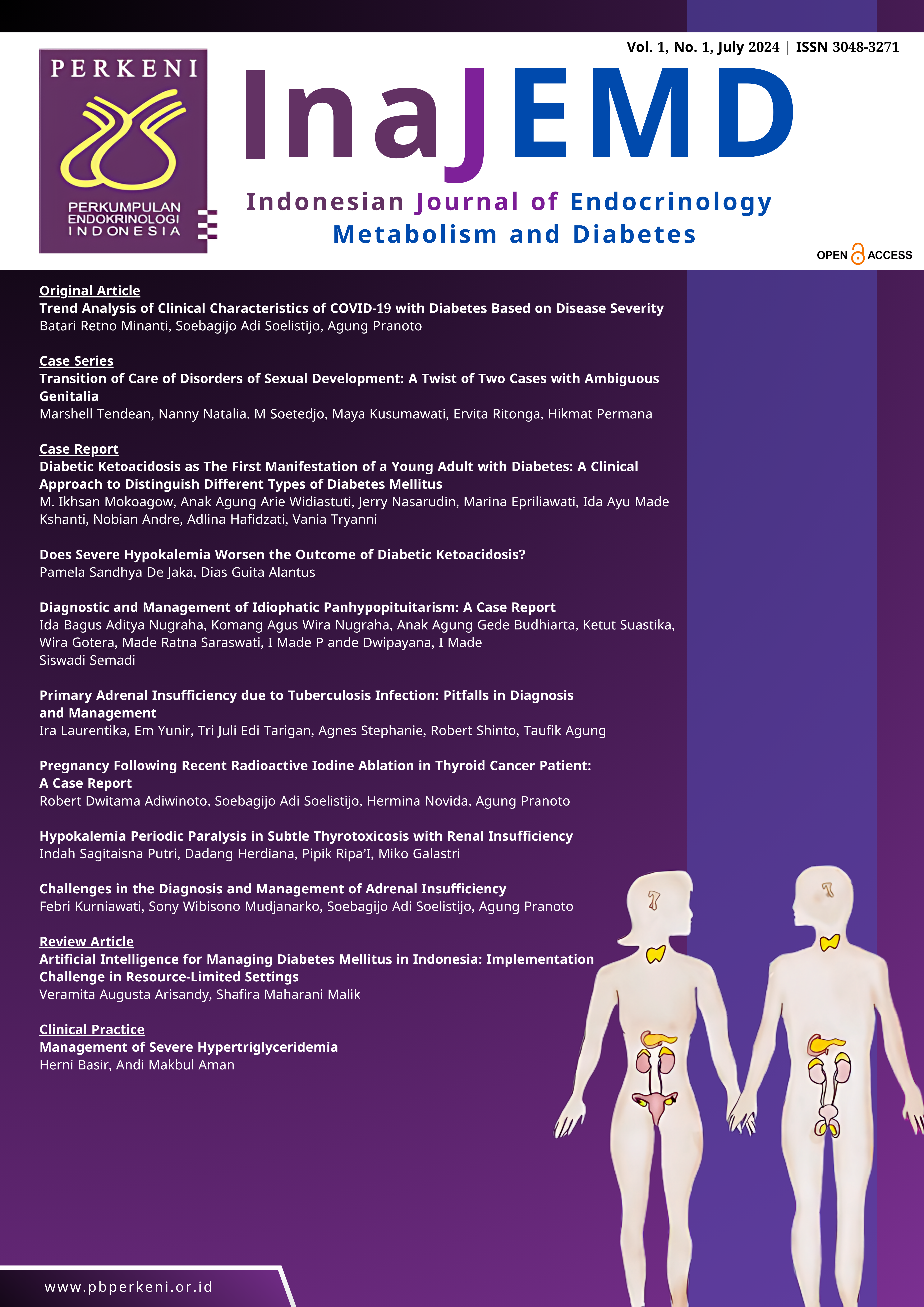
Diabetic Ketoacidosis as The First Manifestation of a Young Adult with Diabetes A Clinical Approach to Distinguish Different Types of Diabetes Mellitus
DOI:
https://doi.org/10.66266/inajemd.v1i1.2Keywords:
Diabetes mellitus, diabetic ketoacidosis , young adult, latent autoimmune diabetes in adultsAbstract
Diabetic ketoacidosis (DKA) is an acute metabolic complication of diabetes. While it most commonly occurs in type 1 diabetes (T1DM), DKA can also occur in other types of diabetes. Encountering a case of DKA prompts further evaluation to determine the type of diabetes and manage patients accordingly. To establish a diagnosis of the type of diabetes in a case with an unusual presentation of DKA through a clinical approach. A 30-year- old male presented to the emergency department with sudden dyspnea. Laboratory examinations showed a blood glucose level of 506 mg/dL, a blood ketone level of 2.6 mmol/L, and a bicarbonate level of 5 mEq/L. His
hemoglobin A1c was 15.3%. He had not been previously diagnosed with diabetes mellitus. Studies have shown overlapping clinical and biochemical parameters of DKA among various types of diabetes. Following life-saving management, further clinical and laboratory evaluations should be performed. Measurement of autoantibody titer (i.e.: autoantibodies against glutamic acid decarboxylase, islet antigen-2, zinc transporter 8, and insulin) and c-peptide levels might help determine the type of diabetes in this patient. Establishing the diagnosis of a certain type of diabetes in young adults can be challenging. Based on clinical profile, a presumptive diagnosis of autoimmune diabetes, particularly latent autoimmune diabetes in adults (LADA), was made in this patient.
Downloads
References
1. Kitabchi AE, Umpierrez GE, Murphy MB, Kreisberg RA. Hyperglycemic crises in adult patients with diabetes: a consensus statement from the American Diabetes Association. Diabetes Care. 2006;29 (12): 2739-48.
2. World Health Organization. Classification of diabetes mellitus. Geneva: World Health Organization; 2019 2019.
3. ElSayed NA, Aleppo G, Aroda VR, Bannuru RR, Brown FM, Bruemmer D, et al. 2. Classification and diagnosis of diabetes: standards of care in diabetes—2023. Diabetes Care. 2022;46 (Supplement_1) :S19-S40.
4. Lizzo JM GA, Gupta V. Adult diabetic ketoacidosis. Treasure Island (FL): StatPearls Publishing; 2022.
5. Barski L, Nevzorov R, Jotkowitz A, Rabaev E, Zektser M, Zeller L, et al. Comparison of diabetic ketoacidosis in patients with type-1 and type-2 diabetes mellitus. Am J Med Sci. 2013;345(4):326-30.
6. Newton CA, Raskin P. Diabetic ketoacidosis in type 1 and type 2 diabetes mellitus: clinical and biochemical differences. Arch Intern Med. 2004;164(17):1925-31.
7. Umpierrez GE, Kitabchi AE. Diabetic Ketoacidosis. Treat Endocrinol. 2003;2 (2):95-108.
8. Wang ZH, Kihl-Selstam E, Eriksson JW. Ketoacidosis occurs in both type 1 and type 2 diabetes a population-based study from Northern Sweden. Diabet Med. 2008;25(7):867-70.
9. Tan H, Zhou Y, Yu Y. Characteristics of diabetic ketoacidosis in Chinese adults and adolescents a teaching hospital-based analysis. Diabetes Res Clin Pract. 2012;97 (2):306-12.
10. Hörber S, Achenbach P, Schleicher E, Peter A. Harmonization of immunoassays for biomarkers in diabetes mellitus. Biotechnol Adv. 2020;39:107359.
11. Unnikrishnan R, Shah VN, Mohan V. Challenges in diagnosis and management of diabetes in the young. Clin Diab and Endocrinol. 2016;2(1):18.
12. Balasubramanyam A. Classification of diabetes mellitus and genetic diabetic syndromes. In: Nathan DM, Wolfsdorf JI, editors. UpToDate. Waltham, MA;2021.
13. Juszczak A, Pryse R, Schuman A, Owen KR. When to consider a diagnosis of MODY at the presentation of diabetes: aetiology matters for correct management. Br J Gen Pract. 2016;66(647):e457-9.
14. Pozzilli P, Pieralice S. Latent autoimmune diabetes in adults: current status and new horizons. Endocrinol Metab (Seoul). 2018; 33(2):147-59.
15. Buzzetti R, Tuomi T, Mauricio D, Pietropaolo M, Zhou Z, Pozzilli P, et al. Management of latent autoimmune diabetes in adults: a consensus statement from an international expert panel. Diabetes. 2020; 69(10):2037-47.
16. Mayo Clinic. Article. Type 1 diabetes; 2023.
17. Diabetes UK. Latent Autoimmune Diabetes in Adults; 2023.
18. Rajkumar V, Levine S. Treasure Island (FL): StatPearls Publishing; 2022.
19. Grönberg A, Espes D, Carlsson P-O. Better HbA1c during the first years after diagnosis of type 1 diabetes is associated with residual C peptide 10 years later. BMJ Open Diab Rese Care. 2020;8(1):e000819.
20. Elsamahy MH, Elhenawy YI, Altayeb N. Long-term prognosis of type 1 diabetes in relation to the clinical characteristics at the onset of diabetes. Egyptian Pediatric Association Gazette. 2017;65(3):90-4
Downloads
Published
Issue
Section
License
Copyright (c) 2024 InaJEMD - Indonesian Journal of Endocrinology Metabolic and Diabetes

This work is licensed under a Creative Commons Attribution-NonCommercial-NoDerivatives 4.0 International License.
Authors retain copyright and grant the Indonesian Journal of Endocrinology, Metabolism and Diabetes (InaJEMD) the right of first publication with the work simultaneously licensed under a Creative Commons Attribution-NonCommercial-NoDerivatives 4.0 International License (CC BY-NC-ND 4.0) that allows others to share the work with an acknowledgement of the work's authorship and initial publication in this journal.
© Indonesian Journal of Endocrinology, Metabolism and Diabetes (InaJEMD). Published by the Indonesian Society of Endocrinology (PERKENI).