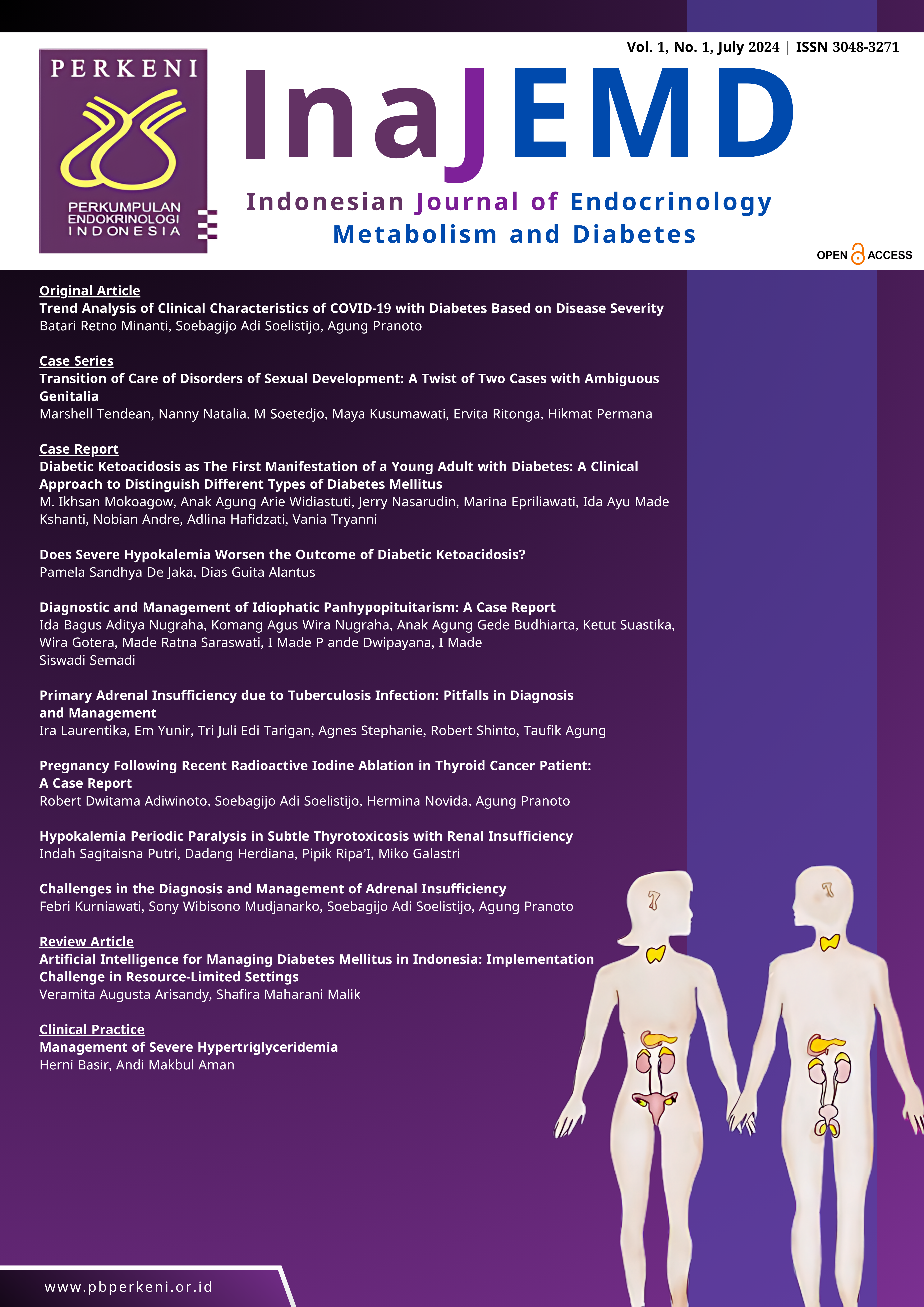
Artificial Intelligence for Managing Diabetes Mellitus in Indonesia Implementation Challenge in Resource-Limited Settings
DOI:
https://doi.org/10.66266/inajemd.v1i1.10Keywords:
Artificial intelligence, diabetes, resource limited settingsAbstract
The existence of Artificial Intelligence (AI) has shaped a significant transformation in healthcare. In the field of endocrinology, AI has been used in the treatment of diabetes mellitus which categorized as one of the leading causes of death in Indonesia. This study is based on a general article review that uncovered the function of AI and its utilization on diabetic care. Currently, AI has grown into a facility that plays a role in health care, such as screening, diagnosis, and recognizing problems. In the scope of diabetes, several AI-based methods and applications have been investigated and played a role in diabetes management such as monitoring blood sugar, setting therapy targets, and dietary adjustment in diabetic patients. Despite the sophistication of AI, there are still several potential risks and barriers, notably in Indonesia, where the limited resources still be an impediment to the use of advanced technology. Lack of data integration and limited accessibility are the common challenges to AI implementation in limited-resources areas. Nevertheless, the application of AI offers numerous prospective benefits, particularly in terms of convenience of use and its efficacy in diabetes management to optimize diabetes care with standardized digital data records, resource improvement, and workload decrease.
Downloads
References
1. International Diabetes Federation. IDF Diabetes Atlas. Brussels, Belgium Int Diabetes Fed. Published online 2017.
2. Russell S, Norvig P. Artificial Intelligence: A Modern Approach (Pearson Series in Artifical Intelligence). 4th ed Pearson. Published online 2020.
3. Mousa A, Maria N, Almuntashiri F, Alsaywid B, Lytras M. The potential of artificial intelligence in healthcare: Perceptions of healthcare practitioners and current adoption. Digital Transformation in Healthcare in Post-Covid-19 Times. Elsevier. Published online 2023:27–41.
4. van Gemert-Pijnen J, Nijlan N, van Limburg M, Al E. A holistic framework to improve the uptake and impact of eHealth technologies. J Med Internet Res. 2011;13(4):e111.
5. Dankwa-Mullan I, Rivo M, Sepulveda M, Park Y, Snowdon J, Rhee K. Transforming diabetes care through artificial intelligence: the future is here. Popul Heal Manag. 2019;22(3):229–42.
6. Ahuja A. The impact of artificial intelligence in medicine on the future role of the physician. PeerJ. 7:e7702.
7. Tsoi K, Yiu K, Lee H, et al. Applications of artificial intelligence for hypertension management. J Clin Hypertens. 23(3):568–74.
8. Yamashita R, Nishio M, Do R, Togashi K. Convolutional neural networks: an overview and application in radiology. Insights Imaging. 2018;9(4):611-629.
9. Ellahham S. Artificial intelligence: the future for diabetes care. Am J Med. 133(8):895–900.
10. Indonesia Ministry of Health. Blueprint for Digital Health Transformation Strategy 2024. Published online 2021:74.
11. McCarthy J. What is artificial intelligence? Published online 1998.
12. Shukla S, Jaiswal V. Applicability of artificial intelligence in different fields of life. IJSER. 2013;1:28-35.
13. Quinn T, Senadeera M, Jacobs S, Coghlan S, Le V. Trust and medical AI: the challenges we face and the expertise needed to overcome them. J Am Med Inf Assoc. 2021;28:890–4.
14. Buch V, Varughese G, Maruthappu M. Artificial intelligence in diabetes care. Diabet Med. 35(4):495-497.
15. US Food and Drug Administration. 2018. FDA permits marketing of artificial intelligence-based device to detect certain diabetes-related eye problems. Access: November 13, 2023. https://www.fda.gov/news-events/press-announcements/fda-permits-marketing-artificial-intelligence-based-device-detect-certain-diabetes-related-eye.
16. Li J, Huang J, Zheng L, Li X. Application of Artificial Intelligence in Diabetes Education and Management: Present Status and Promising Prospect. Front Public Heal. 2020;8:173.
17. Hidalgo JI, Maqueda E, L J, et al. glUCModel: A monitoring and modeling system for chronic diseases applied to diabetes. J Biomed Inform. 2014;48:183-192.
18. Pesl P, Herrero P, Reddy M, et al. Case-Based Reasoning for Insulin Bolus Advice. J Diabetes Sci Technol. 2017;11(1):37-42.
19. Medtronic. Medtronic and IBM Watson Health Partner to Develop New Ways to Tackle Diabetes.
20. Abràmoff M, Lou Y, Erginay A, et al. Improved automated detection of diabetic retinopathy on a publicly available dataset through integration of deep learning. Invest Ophthalmol Vis Sci. 2016;57:5200–6.
21. Abràmoff M, Lavin P, Birch M, Shah N, Folk J. Pivotal trial of an autonomous AI-based diagnostic system for detection of diabetic retinopathy in primary care offices. npj Digit Med. 2018;1:39.
22. Abràmoff M, Folk J, Han D, et al. Automated analysis of retinal images for detection of referable diabetic retinopathy. JAMA Ophthalmol. 2013;131:351–7.
23. Nagaraj S, Sidorenkov G, van Boven J, Denig P. Predicting short- and long-term glycated haemoglobin response after insulin initi- ation in patients with type 2 diabetes mellitus using machine-learning algorithms. Diabetes Obes Metab. 2019;21(12):2704–11.
24. Cichosz S, Johansen M, Hejlesen O. Toward big data analytics: review of predictive models in management of diabetes and its com- plications. J Diabetes Sci Technol. 2016;10(1):27–34.
25. Yap M, Chatwin K, Ng C, Al E. A new mobile application for standardizing diabetic foot images. J Diabetes Sci Technol. 2018;12:169–73.
26. Mahajan A, Taliun D, Thurner M, Al E. Fine-mapping type 2 diabetes loci to single-variant resolution using high-density imputation and islet-specific epigenome maps. Nat Genet. 2018;50:1505–13.
27. Fagherazzi G, Ravaud P. Digital diabetes: perspectives for diabetes prevention, management and research. Diabetes Metab. 2019;45(4):322–9.
28. Frøisland D, Årsand E. Integrating visual dietary documentation in mobile-phone-based self-management application for adolescents with type 1 diabetes. J Diabetes Sci Technol. 2015;9(3):541-548.
29. Gabarron E, Aorsand E, Wynn R. Social media use in interventions for diabetes: rapid evidence-based review. J Med Internet Res. 2018;20(8):e10303.
30. Sumari ADW. The Contributions of Artificial Intelligence in Achieving Sustainable Development Goals: Indonesia Case. Eng, IOP Conf Ser Mater Sci. Published online 2020:982.
31. Kuntardjo C. Dimensions of Ethics and Telemedicine in Indonesia: Enough of Permenkes Number 20 Year 2019 As a Frame of Telemedicine Practices in Indonesia? Soepra. 2020;6(1):1–14.
32. Wahl B, Cossy-Gantner A, Germann S, Schwalbe N. Artificial intelligence (AI) and global health: how can AI contribute to health in resource-poor settings? BMJ Glob Heal. 2018;3(4):e000798.
33. Guo J, Li B. The application of medical artificial intelligence technology in rural areas of developing countries. Heal Equity. 2018;2(1):174–81.
34. Kalyanakrishnan S, Panicker R, Natarajan S, Rao S. Opportunities and Challenges for Artificial Intelligence in India. Proceedings of the 2018 AAAI/ACM conference on AI, Ethics, and Society. Published online 2018:164–170.
35. Alami H, Rivard L, Lehoux P, et al. Artificial intelligence in health care: laying the Foundation for Responsible, sustainable, and inclusive innovation in low- and middle-income countries. Glob Heal. 16(1):52.
36. Sunarti S, Fadzlul Rahman F, Naufal M, Risky M, Febriyanto K, Masnina R. Artificial intelligence in healthcare: opportunities and risk for future. Gac Sanit. 2021;35 Suppl 1:S67–70.
37. Thomford N, Bope C, Agamah F, et al. Implementing Artificial Intelligence and Digital Health in Resource-Limited Settings? Top 10 Lessons We Learned in Congenital Heart Defects and Cardiology. OMICS. 24(5):264–77.
38. Fisher S, Rosella L. Priorities for successful use of artificial intelligence by public health organizations: a literature review. BMC Public Health. 2022;22:2146.
39. Neborachko M, Pkhakadze A, Vlasenko I. Current trends of digital solutions for diabetes management. Diabetes Metab Syndr. 2019;13(5):2997–3003.
40. Hasanzad M, Aghaei Meybodi, HR, Sarhangi N, Larijani B. Artificial intelligence perspective in the future of endocrine diseases. J Diabetes Metab Disord. 2022;21(1):971–8.
41. Aquino JY Saint, Rogers WA, Braunack-Mayer A, et al. Utopia versus dystopia: Professional perspectives on the impact of healthcare artificial intelligence on clinical roles and skills. Int J Med Inform. 2023;169.
42. Lu J. Will Medical Technology Deskill Doctors? Int Educ Stud. 2016;9:130-134.
43. Becker A. Artificial intelligence in medicine: What is it doing for us today? Heal Policy Technol. 2019;8:198-205.
44. Panch T, Szolovits P, Atun R. Artificial intelligence, machine learning and health systems. J Glob Heal. 8(2):020303.
45. Lin SY, Mahoney MR, Sinsky CA. Ten ways artificial intelligence will transform primary care. J Gen Intern Med. 2019;34(8):1626–30.
Downloads
Published
Issue
Section
License
Copyright (c) 2024 InaJEMD - Indonesian Journal of Endocrinology Metabolic and Diabetes

This work is licensed under a Creative Commons Attribution-NonCommercial-NoDerivatives 4.0 International License.
Authors retain copyright and grant the Indonesian Journal of Endocrinology, Metabolism and Diabetes (InaJEMD) the right of first publication with the work simultaneously licensed under a Creative Commons Attribution-NonCommercial-NoDerivatives 4.0 International License (CC BY-NC-ND 4.0) that allows others to share the work with an acknowledgement of the work's authorship and initial publication in this journal.
© Indonesian Journal of Endocrinology, Metabolism and Diabetes (InaJEMD). Published by the Indonesian Society of Endocrinology (PERKENI).