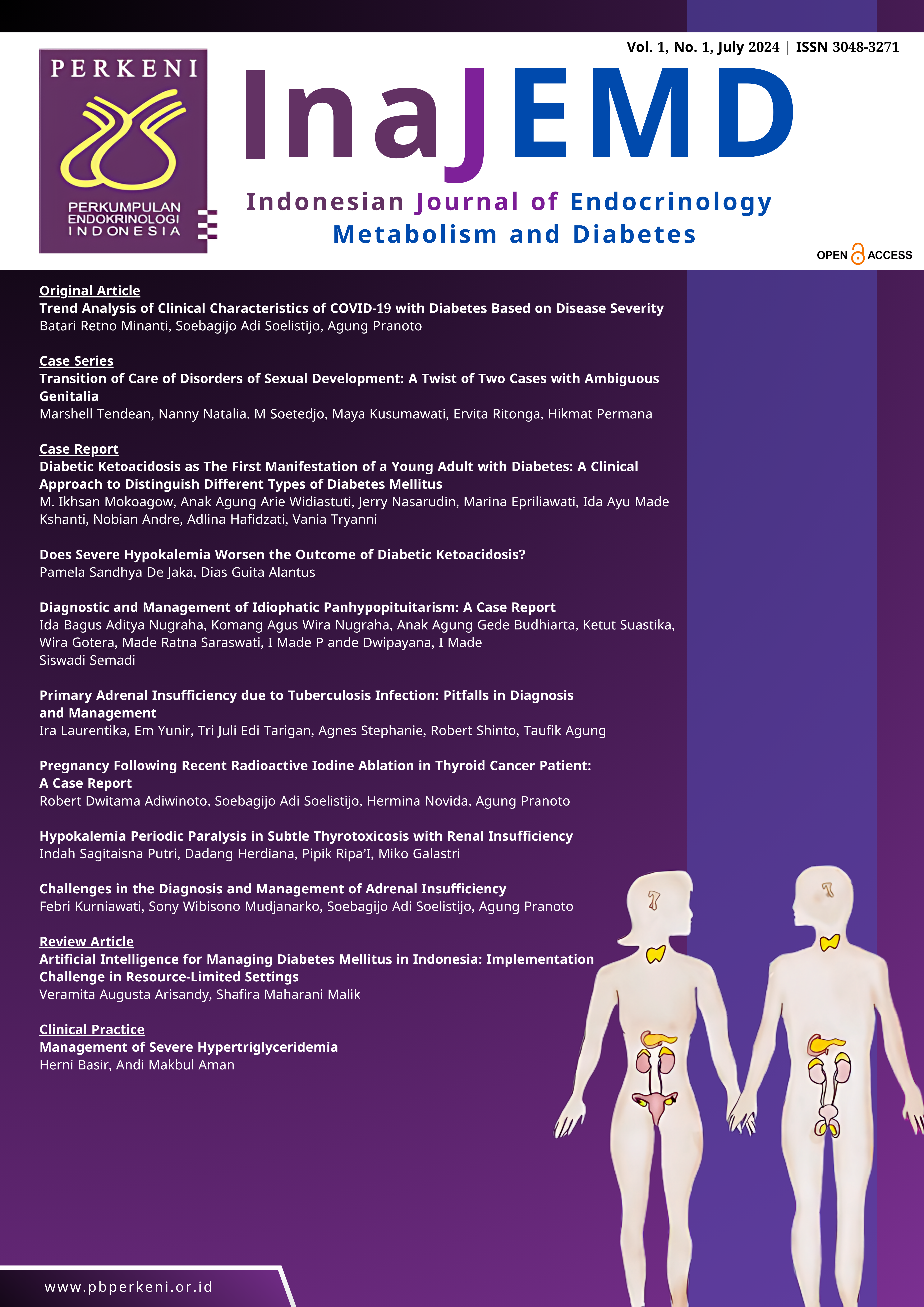
Pregnancy Following Recent Radioactive Iodine Ablation in Thyroid Cancer Patient A Case Report
DOI:
https://doi.org/10.66266/inajemd.v1i1.7Keywords:
Thyroid carcinoma, pregnancy, radioactive iodine ablationAbstract
Well-differentiated thyroid carcinoma (DTC) is common among females of reproductive age. Pregnancy is associated with hormonal (TSH and HCG) and metabolic changes that might affect the thyroid gland. Information
regarding the outcome of babies born to mothers who have recently undergone radioactive Iodine-131 ablation (RAI) is scarce. A 24-year-old pregnant woman with a history of thyroid cancer was consulted by the obstetrics and gynecology for further evaluation. She complained of a lump under the left jaw, and a thyroid nodule was found from further examination. Postoperative pathology of the right thyroid tissue revealed follicular and solid variant papillary thyroid carcinoma. Postoperative Thyroglobulin (Tg) level before ablation was 16.14 ng/mL. Ablation with Iodine-131 of 100 mCi was performed. Whole-body scintigraphy (WBS) indicated remaining functional thyroid tissue in the right thyroid field and thyroid tissue metastases in the left supraclavicular area. The patient was
pregnant 3 months after the radioablation. Fetomaternal examination results 6 months pregnancy revealed fetal biometry according to gestational age (31 – 32 weeks) with an estimated fetal weight of 1787 grams and fetal doppler was normal. The patient is treated with levothyroxine 125 μ g once daily, folic acid 400 μ g twice daily, calcium lactate twice daily, and aspirin 80 mg once daily. The TSH level was 0.01 (0.55 – 4.78) μ IU/mL and the fT4 was 1.14 (0.7 – 1.48) ng/dL. The latest thyroid ultrasound indicated no discrete mass in the thyroid fossa and non-
specific lymphadenopathies. The baby was born normally, weighed 2680 grams, with normal thyroid function tests (neonatal TSH 1.02 μ IU/mL, fT4 2.6 ng/dL).
Downloads
References
1. Giray B, Buyukbayrak EE, Turhan OT, Karsidag AYK. Thyroid papillary cancer-related pregnancy: a case report. Case Rep in Perin Med 6.1 (2017): 20160058.
2. Lamartina L, Grani G, Durante C, Borget I, Filetti S, Schlumberger M. Follow-up of differentiated thyroid cancer – what should (and what should not) be done. Nat Rev Endocrinol. 2018;14(9):538–51.
3. Imran SA, Rajaraman M. Management of Differentiated Thyroid Cancer in Pregnancy. Vaidya B, editor. J Thyroid Res. 2011; 2011:549609.
4. Haugen BR, Alexander EK, Bible KC, Doherty GM, Mandel SJ, Nikiforov YE, et al. 2015 American Thyroid Association Management Guidelines for Adult Patients with Thyroid Nodules and Differentiated Thyroid Cancer: The American Thyroid Association Guidelines Task Force on Thyroid Nodules and Differentiated Thyroid Cancer. Thyroid. 2015; 14;26(1):1–133.
5. Houten P van, Netea-Maier RT, Smit JW. Differentiated thyroid carcinoma: An update. Best Pract Res Clin Endocrinol Metab. 2023;37(1):101687.
6. Limaiem F, Rehman A, Mazzoni T. Papillary thyroid carcinoma. 2019.
7. Sisson, The American Thyroid Association Taskforce on Radioiodine Safety; James C., et al. Radiation safety in the treatment of patients with thyroid diseases by radioiodine practice. The Americ Thyr Asso. 21.4 (2011): 335-346.
8. Colombo C, De Leo S, Giancola N, Trevisan M, Ceruti D, Frattini F, et al. Persistent thyroid carcinoma and pregnancy: outcomes in an italian series and review of the literature. Cancers (Basel). 2022; 14(22):5515.
9. Sutjahjo A, Wironegoro R, Novida H. Gangguan Tiroid dan Kehamilan. In: Tjokroprawiro A, Setiawan PB, Chaerul E, Santoso D, Soegiarto G, editors. Buku ajar ilmu penyakit dalam. 2nd ed. Surabaya: Airlangga University Press; 2015. p. 160–7. 10.Jemal A, Siegel R, Ward E, Murray T, Xu J, Thun MJ. Cancer statistics, 2007. CA Cancer J Clin. 2007;57(1):43–66.
11. Kravdal Oystein, Glattre E, Haldorsen T. Positive correlation between parity and incidence of thyroid cancer: new evidence based on complete Norwegian birth cohorts. Int J Cancer. 1991;49(6):831–6.
12. Mack WJ, Preston-Martin S, Bernstein L, Qian D, Xiang M. Reproductive and hormonal risk factors for thyroid cancer in Los Angeles County females. Cancer Epid Biomark & Prev. 1999;8(11):991–7.
13. Hannibal CG, Jensen A, Sharif H, Kjaer SK. Risk of thyroid cancer after exposure to fertility drugs: results from a large Danish cohort study. Hum Rep. 2008 1;23(2):451–6.
14. Moon S, Yi KH, Park YJ. Risk of adverse pregnancy outcomes in young women with thyroid cancer: a systematic review and meta-analysis. Cancers (Basel). 2022;14(10):1-16.
15. Kim HO, Lee K, Lee SM, Seo GH. Association between pregnancy outcomes and radioactive iodine treatment after thyroidectomy among women with thyroid cancer. JAMA Intern Med. 2020 Jan 1;180(1):54–61.
16. Schlumberger M, De Vathaire F, Ceccarelli C, Delisle MJ, Francese C, Couette JE, et al. Exposure to radioactive iodine-131 for scintigraphy or therapy does not preclude pregnancy in thyroid cancer patients. J of Nucl Med. 1996;37(4):606–12.
17. Tran P, DeSimone S, Barrett M, Bachrach B. I-131 Treatment of graves’ disease in an unsuspected first trimester pregnancy; the potential for adverse effects on the fetus and a review of the current guidelines for pregnancy screening. Int J Pediatr Endocrinol. 2010;2010(1):1-3.
18. Alexander EK, Pearce EN, Brent GA, Brown RS, Chen H, Dosiou C, et al. 2017 Guidelines of the American Thyroid Association for the Diagnosis and Management of Thyroid Disease During Pregnancy and the Postpartum. Thyroid. 2017 Jan 6;27(3):315–89.
19. Kim MR, Park HW, Chung S. A baby with congenital hypothyroidism born to a hypothyroid mother who expressed undiagnosed thyroid stimulation blocking antibody. Ann Pediatr Endocrinol Metab. 2016;21(3):161.
Downloads
Published
Issue
Section
License
Copyright (c) 2024 InaJEMD - Indonesian Journal of Endocrinology Metabolic and Diabetes

This work is licensed under a Creative Commons Attribution-NonCommercial-NoDerivatives 4.0 International License.
Authors retain copyright and grant the Indonesian Journal of Endocrinology, Metabolism and Diabetes (InaJEMD) the right of first publication with the work simultaneously licensed under a Creative Commons Attribution-NonCommercial-NoDerivatives 4.0 International License (CC BY-NC-ND 4.0) that allows others to share the work with an acknowledgement of the work's authorship and initial publication in this journal.
© Indonesian Journal of Endocrinology, Metabolism and Diabetes (InaJEMD). Published by the Indonesian Society of Endocrinology (PERKENI).