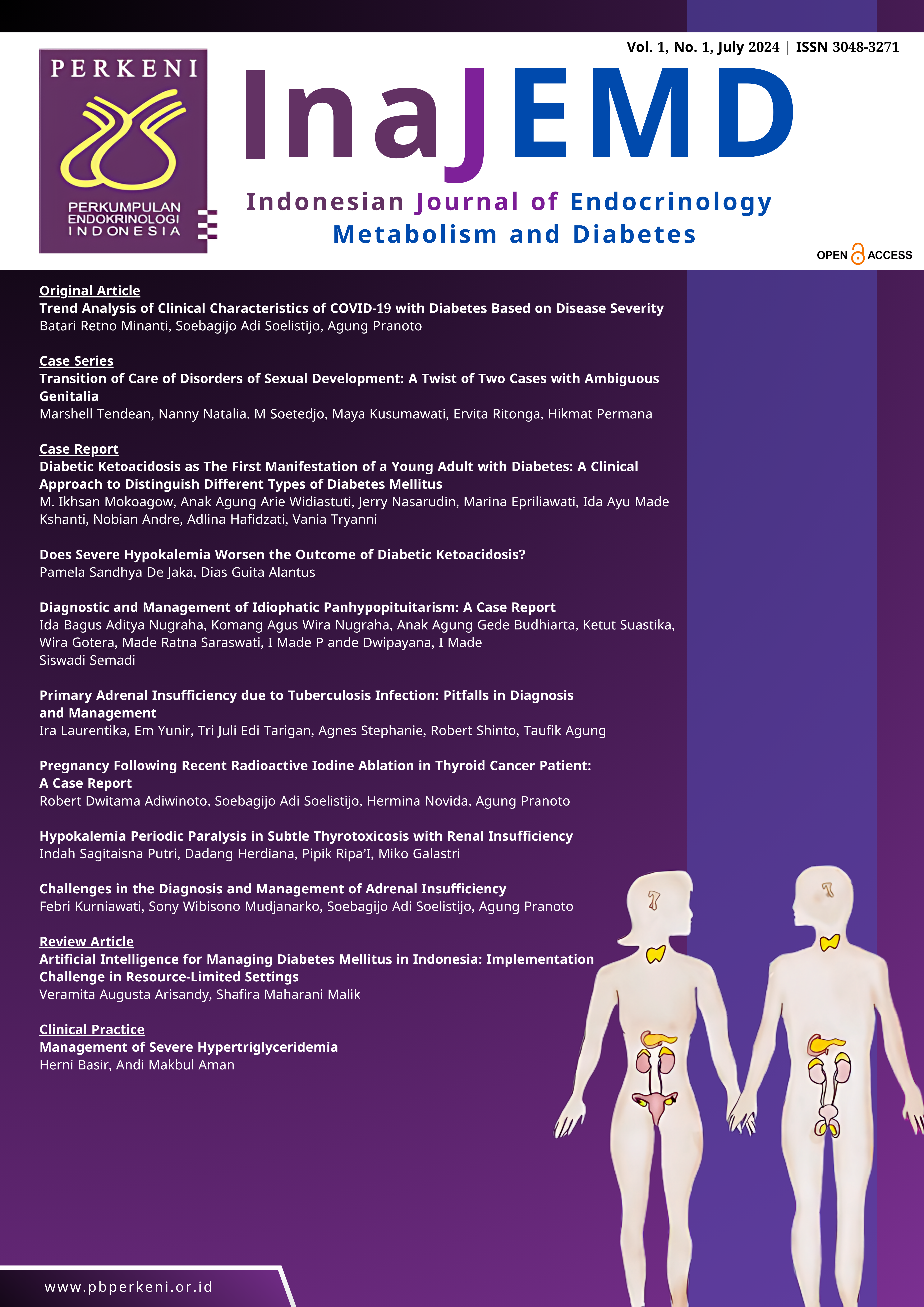
Does Severe Hypokalemia Worsen the Outcome of Diabetic Ketoacidosis
DOI:
https://doi.org/10.66266/inajemd.v1i1.4Keywords:
Diabetes, diabetic ketoacidosis , hypokalemia, sepsis, insulinAbstract
Hypokalemia is an uncommon finding in the initial evaluation of patients with DKA before insulin treatment. However, it can complicate the management of DKA and lead to a worse prognosis. Hypokalemia in DKA may result from a combination of factors, including kaliuresis, secondary osmotic diuresis, inadequate oral intake, and gastrointestinal losses such as vomiting. We report the case of a 31-year-old woman who recently experienced diabetic ketoacidosis with severe dehydration, severe hypokalemia, and sepsis. Unfortunately, her condition deteriorated, and she eventually went into cardiac arrest while receiving treatment in the emergency unit. This case highlights the challenges involved in providing therapy and managing complications that arise in patients, presenting a dilemma for healthcare providers
Downloads
References
1. Kempegowda P, Chandan JS, Coombs B. Regular performance feedback may be key to maintain good quality DKA management: results from a five-year study BMJ Open 2019;7: e000695.
2. Badawy MK, Viswanath V, Khetriwal B, Pradhan S, Williams RM, Pathan N, et al. Diabetic ketoacidosis with severe hypokalemia and persistent hypernatremia in an adolescent girl with Covid‐19 infection. Clinical Case Reports. 2022;10(2): e05406.
3. Eledrisi MS, Elzouki AN. Management of diabetic ketoacidosis in adults: A narrative review. Saudi J Med Med Sci 2020;8:165-73.
4. Fayfman M, Pasquel FJ, Umpierrez GE. Management of hyperglycemic crises: diabetic ketoacidosis and hyperglycemic hyperosmolar state. Med Clin North Am. 2017;101(3):587-606.
5. Fayfman M, Pasquel FJ, Umpierrez GE. Management of hyperglycemic crises. Medical Clinics of North America. 2017;101(3):587–606.
6. Galm BP, Bagshaw SM, Senior PA. Acute management of diabetic ketoacidosis in adults at 3 teaching hospitals in Canada: A Multicentre, retrospective cohort study. Canadian Journal of Diabetes. 2019;43(5).
7. Kitabchi & Ebenezer. The evolution of diabetic ketoacidosis: An update of its etiology, pathogenesis, and management. Elsevier Inc. 2016; 65(4): 507-521.
8. Grout S, Maue D, Berrens Z, Swinger N, Malin S. Diabetic ketoacidosis with refractory hypokalemia leading to cardiac arrest. Cureus. 2022; 14(3).
9. Coregliano-Ring L, Goia-Nishide K, Rangel ÉB. Hypokalemia in diabetes mellitus setting. Medicina. 2022;58(3):431.
10. Azova S, Rapaport R, Wolfsdorf J. Brain injury in children with diabetic ketoacidosis: Review of the literature and a proposed pathophysiologic pathway for the development of cerebral edema. Pediatric Diabetes. 2020;22(2):148–60.
11. Natarajan S, Kulkarni R, Tangri A. Fatal cerebral edema in a young adult with diabetic ketoacidosis: Blame the bicarbonate? Case Reports in Crit Care Med. 2020;1–4.
12. Rehan HS, Hotha P. Antimicrobial agents-induced hypokalemia: A possible causality association. Ind J of Critical Care Medicine. 2019;23(4):175–7.
13. Collins AJ, Pitt B, Reaven N, et al. Association of serum potassium with all-cause mortality in patients with and without heart failure, chronic kidney disease, and/or diabetes. Am J Nephrol. 2017;46(3):213-221.
14. Davis SM, Maddux AB, Alonso GT, Okada CR, Mourani PM, Maahs DM. Profound hypokalemia associated with severe diabetic ketoacidosis. Pediatr Diabetes. 2016 Feb;17(1):61-5.
15. Khiatah B, Frugoli A, Carlson D (July 21, 2023) The clinical caveat for treating persistent hypokalemia in diabetic ketoacidosis. Cureus 15(7): e42272.
Downloads
Published
Issue
Section
License
Copyright (c) 2024 InaJEMD - Indonesian Journal of Endocrinology Metabolic and Diabetes

This work is licensed under a Creative Commons Attribution-NonCommercial-NoDerivatives 4.0 International License.
Authors retain copyright and grant the Indonesian Journal of Endocrinology, Metabolism and Diabetes (InaJEMD) the right of first publication with the work simultaneously licensed under a Creative Commons Attribution-NonCommercial-NoDerivatives 4.0 International License (CC BY-NC-ND 4.0) that allows others to share the work with an acknowledgement of the work's authorship and initial publication in this journal.
© Indonesian Journal of Endocrinology, Metabolism and Diabetes (InaJEMD). Published by the Indonesian Society of Endocrinology (PERKENI).